Faucet Chrome Plating: A Complete Process Guide
Faucet chrome plating is an electrochemical process that deposits a layer of chromium metal on the metal surface, providing aesthetic and durable surface protection for faucets 6. Chrome plating not only gives the faucet a bright and beautiful appearance, but more importantly, it can effectively improve its corrosion resistance and wear resistance.
Last Updated: September 2025 | Estimated Reading Time: 15 Minutes
This Article Will Answer:
- What is chrome plating?
- What is the complete chrome plating process?
- What are the precautions for chrome plating faucets of different materials?
- How to detect chrome plating quality?
- How to perform daily maintenance of chrome-plated faucets?
What is Chrome Plating?
Chrome plating is an electrochemical process that deposits a layer of chromium metal on the metal surface 6. The purpose of chrome plating is to form a thin and uniform chromium coating on the surface of the faucet. Chrome plating provides beautiful and durable surface protection for faucets, giving them excellent corrosion resistance and wear resistance 6.
Advantages of Chrome Plating
- Excellent corrosion resistance:Effectively resists erosion from water and chemicals 6.
- Excellent wear resistance:Ensures long-lasting beauty 6.
- Hygienic and easy to clean:Smooth surface is easy to clean 6.
- Aesthetic appeal:Mirror effect enhances product grade 6.
Complete Chrome Plating Process
Chrome plating usually includes the following key steps:
- Pre-treatment Stage
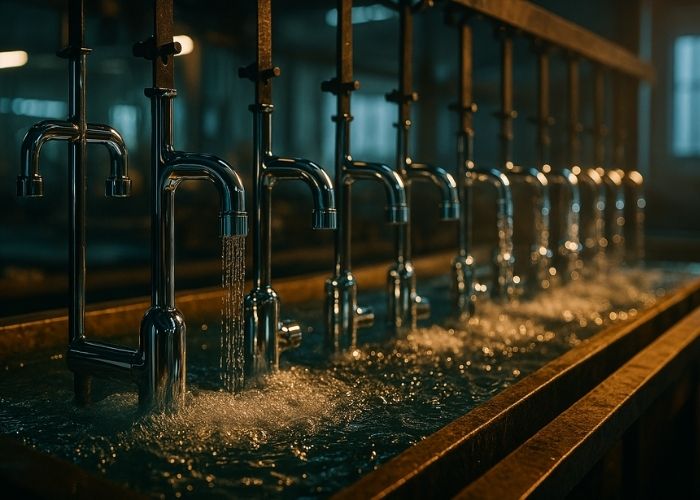
- Polishing:Fine polishing of copper or stainless steel substrates 6.
- Degreasing: Thorough removal of oil and impurities with chemical solvents 6.
- Acid pickling: Removal of oxides through acid treatment 6.
- Plating Solution Preparation
- Chromic acid solution: Preparation of specific concentration electrolyte 6.
- Catalyst addition: Adding sulfuric acid to improve plating quality 6.
- Temperature control: Precise control at 50-60°C range 6.
- Electroplating Process Control
- Current density: Strict control for uniform coating 6.
- Time management: Adjustment based on thickness requirements 6.
- pH monitoring: Real-time pH value monitoring 6.
- Post-treatment Process
- Cleaning and neutralization: Complete removal of residual electrolyte 6.
- Passivation treatment: Chromic acid passivation for corrosion resistance 6.
- Drying and packaging: Low-temperature drying with anti-scratch packaging 6.
Key Points of Chrome Plating for Faucets of Different Materials
However, different materials of faucets require different processes and precautions during chrome plating to ensure the final coating quality.
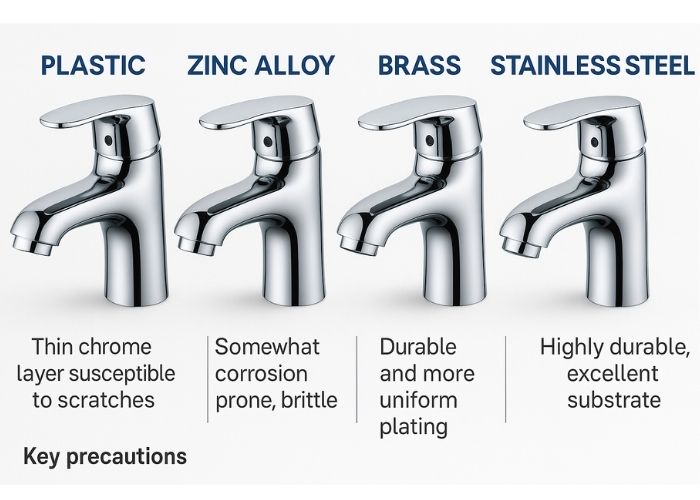
Plastic Faucets
- Since the surface of plastic is non-conductive, special conductive treatment is required before chrome plating, such as chemical plating or vacuum coating, and then electroplating. The adhesion of plastics is the worst.
- Precautions:
- Choose plastic materials that are resistant to high temperature and chemical corrosion.
- Strictly control the pretreatment process to avoid damage to the plastic surface.
- Use appropriate chrome plating solution and process parameters to prevent the coating from blistering and falling off.
- Zinc Alloy Faucets
- Zinc alloy has good casting performance and mechanical properties, but its corrosion resistance is poor and needs to be improved by chrome plating.
- Precautions:
- Control the composition and purity of zinc alloy to reduce impurity content.
- Use appropriate pretreatment process to remove the oxide film on the surface of zinc alloy.
- Control the composition and process parameters of the chrome plating solution to prevent cracks and pinholes in the coating.
- Brass Faucets
- Brass has good corrosion resistance and processing performance, and is a commonly used material for high-end faucets.
- Precautions:
- Choose high-quality brass materials to ensure that their composition meets the standards.
- Use appropriate pretreatment process to remove the oxide film and oil stains on the surface of the brass.
- Control the composition and process parameters of the chrome plating solution to ensure that the coating is bright and uniform.
- Stainless Steel Faucets
- Stainless steel has excellent corrosion resistance and mechanical properties, but its surface is not easy to combine with other metals, and chrome plating is more difficult.
- Precautions:
- Choose suitable stainless steel materials, such as 304 or 316 stainless steel.
- Use a special pretreatment process to activate the surface of stainless steel and improve the coating adhesion.
- Use special chrome plating solution and process parameters to prevent the coating from peeling off or blistering.
Chrome Plating Quality Inspection Methods
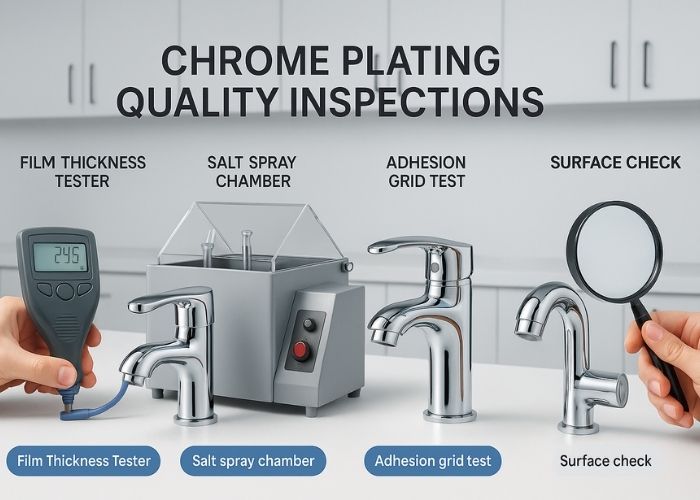
In order to ensure the quality of chrome plating, a series of tests need to be carried out, including:
- Film Thickness Test:Use a film thickness tester to measure the thickness of the coating to ensure that it meets the standard requirements. Generally speaking, the nickel plating thickness of faucets is 3 to 6 microns, and the chromium plating thickness is 0.15 microns. A good electroplating thickness is 8 to 15 microns for nickel and about 0.3 microns for chromium.
- Adhesion Test:Use the grid method, bending method and other methods to test the bonding force between the coating and the base metal.
- Salt Spray Test:Place the faucet in a salt spray test chamber to simulate the marine environment, accelerate corrosion, and evaluate the corrosion resistance of the coating. In terms of salt spray test values, the electroplating thickness of general brass faucets can reach 96 hours in neutral salt spray test, and the electroplating thickness of good faucets can reach 200 hours in neutral salt spray test; Of course, the salt spray test is also related to the material, and the adhesion of plastic is the worst.
- Appearance Inspection:Visually inspect whether there are defects such as bubbles, cracks and peeling on the surface of the coating.
Maintenance Recommendations for Chrome-Plated Faucets
- Regularly wipe with a soft cloth 6.
- Avoid using abrasive cleaners 6.
- Remove water stains promptly 6.
Limitations of Chrome Plating
Although chrome plating has many advantages, it also has some limitations:
- Environmental pollution:The chromate and other chemicals used in the chrome plating process are toxic and will pollute the environment.
- High cost:The chrome plating process is relatively complex and costly.
- Thin coating:The chrome plating layer is usually thin and easily damaged by mechanical damage.
Alternatives to Chrome Plating
With the increasing awareness of environmental protection and technological progress, some alternatives to chrome plating are emerging, such as:
- PVD coating:Physical vapor deposition technology is used to form a dense coating on the surface of the material, which has excellent wear resistance and corrosion resistance.
- Powder coating:Electrostatic spraying technology is used to evenly coat the powder coating on the surface of the material, and then it is cured by baking to form a solid coating.
- Anodizing:Suitable for aluminum alloy materials, electrochemical oxidation is used to form an oxide film on the surface of the aluminum alloy to improve its corrosion resistance and wear resistance.
Conclusion
Faucet chrome plating is an important surface treatment process that can effectively improve the corrosion resistance and aesthetics of faucets. By understanding the chrome plating process, precautions, quality inspection methods and alternative solutions, you can better select and maintain chrome-plated faucets and enjoy a comfortable and healthy life.
Recommended Internal Links:
- Faucet Buying Guide: https://www.faucetproducer.com/blog-detail/how-to-buy-a-faucet?
Recommended External Links:
- National Association for Surface Finishing https://www.nasf.org/
- Electroplating - Wikipedia https://en.wikipedia.org/wiki/%E9%9B%BB%E9%8E%A7


